 Add to Chrome
 Add to Firefox
 Add to Edge
GRKV: Global Regression for Training-Free KV Cache Compression in Long-Context LLMs
May 29, 2026
Large language models (LLMs) with extended context lengths rely on the key-value (KV) cache to support attention over prior tokens. However, maintaining the KV cache incurs substantial memory overhead, motivating KV-cache compression methods that enforce a fixed budget through eviction and merging. Modern eviction methods increasingly adopt span-based retention because preserving contiguous spans is empirically effective and better preserves semantic coherence. Yet, when combined with post-eviction merging, span-based retention concentrates merges onto a small set of span-boundary carrier tokens, producing a highly imbalanced merge pattern that exacerbates over-merging and increases information loss. To address this imbalance, we propose GRKV (Global Regression for KV Cache), a training-free KV-cache merging method that directly minimizes the discrepancy between compressed-cache and full-cache attention outputs. GRKV uses ridge-regression-based merge steps to distribute information from evicted tokens across retained tokens, while regularizing the updates to prevent over-smoothing. Across the LongBench and RULER long-context benchmarks, GRKV is the only merging method that improves overall performance with minimal overhead.

View-Aware Semantic Alignment for Aerial-Ground Person Re-Identification
May 18, 2026Aerial-Ground Person Re-Identification (AGPReID) remains highly challenging due to drastic viewpoint variations between drones and fixed cameras. Existing methods typically follow a view-invariant paradigm, aligning shared features across views to achieve robustness. However, view-invariant inherently enforces part-level alignment, which ignores view-specific cues and discriminative identity information. To this end, this work proposes ViSA (View-aware Semantic Alignment), a view-aware framework that achieves cross-view semantic consistency containing an Expert-driven Token Generation Module (ETGM) and a Dual-branch Local Fusion Module (DLFM). Technically, the former constructs a set of view-aware experts to generate adaptive semantic queries that perceive viewpoint-specific patterns, while the latter leverages graph reasoning to extract and align local regions responsive to different experts. Extensive experiments on three AGPReID benchmarks including AG-ReID.v2, CARGO and LAGPeR demonstrate that ViSA consistently achieves superior performance, with a notable 10.06\% mAP improvement on the challenging CARGO cross-view protocol. The code is available at \href{https://github.com/Cat-Zero/ViSA}{https://github.com/Cat-Zero/ViSA}.
HarmoGS: Robust 3D Gaussian Splatting in the Wild via Conflict-Aware Gradient Harmonization
May 13, 2026In-the-wild 3D Gaussian Splatting remains challenging due to transient distractors and illumination-induced cross-view appearance inconsistencies. Existing methods mainly rely on image-level masking to suppress unreliable supervision, but masking alone cannot fully eliminate residual occlusions or resolve illumination-induced inconsistencies, both of which can introduce conflicting cross-view gradients. These unresolved conflicts may destabilize Gaussian optimization and lead to visible reconstruction artifacts. We propose a conflict-aware 3DGS framework that addresses this problem from both image-space supervision and gradient-level optimization. Semantic Consistency-Guided Masking learns pixel-wise consistency scores to adaptively refine prior masks and suppress unreliable supervision before gradient formation. A dual-view Conflict-Aware Gradient Harmonization strategy further reconciles view-specific gradients by mutually rotating them into an orthogonal configuration, reducing negative directional interference across views. We also introduce conflict-aware densification and pruning to stabilize Gaussian growth and remove persistently conflicting primitives. Extensive experiments on standard in-the-wild benchmarks demonstrate that our method achieves state-of-the-art rendering quality under complex transient distractors and cross-view inconsistencies.
Thinking Before Matching: A Reinforcement Reasoning Paradigm Towards General Person Re-Identification
Apr 21, 2026Learning identity-discriminative representations with multi-scene generality has become a critical objective in person re-identification (ReID). However, mainstream perception-driven paradigms tend to identify fitting from massive annotated data rather than identity-causal cues understanding, which presents a fragile representation against multiple disruptions. In this work, ReID-R is proposed as a novel reasoning-driven paradigm that achieves explicit identity understanding and reasoning by incorporating chain-of-thought into the ReID pipeline. Specifically, ReID-R consists of a two-stage contribution: (i) Discriminative reasoning warm-up, where a model is trained in a CoT label-free manner to acquire identity-aware feature understanding; and (ii) Efficient reinforcement learning, which proposes a non-trivial sampling to construct scene-generalizable data. On this basis, ReID-R leverages high-quality reward signals to guide the model toward focusing on ID-related cues, achieving accurate reasoning and correct responses. Extensive experiments on multiple ReID benchmarks demonstrate that ReID-R achieves competitive identity discrimination as superior methods using only 14.3K non-trivial data (20.9% of the existing data scale). Furthermore, benefit from inherent reasoning, ReID-R can provide high-quality interpretation for results.
Style4D-Bench: A Benchmark Suite for 4D Stylization
Aug 26, 2025We introduce Style4D-Bench, the first benchmark suite specifically designed for 4D stylization, with the goal of standardizing evaluation and facilitating progress in this emerging area. Style4D-Bench comprises: 1) a comprehensive evaluation protocol measuring spatial fidelity, temporal coherence, and multi-view consistency through both perceptual and quantitative metrics, 2) a strong baseline that make an initial attempt for 4D stylization, and 3) a curated collection of high-resolution dynamic 4D scenes with diverse motions and complex backgrounds. To establish a strong baseline, we present Style4D, a novel framework built upon 4D Gaussian Splatting. It consists of three key components: a basic 4DGS scene representation to capture reliable geometry, a Style Gaussian Representation that leverages lightweight per-Gaussian MLPs for temporally and spatially aware appearance control, and a Holistic Geometry-Preserved Style Transfer module designed to enhance spatio-temporal consistency via contrastive coherence learning and structural content preservation. Extensive experiments on Style4D-Bench demonstrate that Style4D achieves state-of-the-art performance in 4D stylization, producing fine-grained stylistic details with stable temporal dynamics and consistent multi-view rendering. We expect Style4D-Bench to become a valuable resource for benchmarking and advancing research in stylized rendering of dynamic 3D scenes. Project page: https://becky-catherine.github.io/Style4D . Code: https://github.com/Becky-catherine/Style4D-Bench .
ObjFiller-3D: Consistent Multi-view 3D Inpainting via Video Diffusion Models
Aug 25, 20253D inpainting often relies on multi-view 2D image inpainting, where the inherent inconsistencies across different inpainted views can result in blurred textures, spatial discontinuities, and distracting visual artifacts. These inconsistencies pose significant challenges when striving for accurate and realistic 3D object completion, particularly in applications that demand high fidelity and structural coherence. To overcome these limitations, we propose ObjFiller-3D, a novel method designed for the completion and editing of high-quality and consistent 3D objects. Instead of employing a conventional 2D image inpainting model, our approach leverages a curated selection of state-of-the-art video editing model to fill in the masked regions of 3D objects. We analyze the representation gap between 3D and videos, and propose an adaptation of a video inpainting model for 3D scene inpainting. In addition, we introduce a reference-based 3D inpainting method to further enhance the quality of reconstruction. Experiments across diverse datasets show that compared to previous methods, ObjFiller-3D produces more faithful and fine-grained reconstructions (PSNR of 26.6 vs. NeRFiller (15.9) and LPIPS of 0.19 vs. Instant3dit (0.25)). Moreover, it demonstrates strong potential for practical deployment in real-world 3D editing applications. Project page: https://objfiller3d.github.io/ Code: https://github.com/objfiller3d/ObjFiller-3D .
Distilled-3DGS:Distilled 3D Gaussian Splatting
Aug 19, 20253D Gaussian Splatting (3DGS) has exhibited remarkable efficacy in novel view synthesis (NVS). However, it suffers from a significant drawback: achieving high-fidelity rendering typically necessitates a large number of 3D Gaussians, resulting in substantial memory consumption and storage requirements. To address this challenge, we propose the first knowledge distillation framework for 3DGS, featuring various teacher models, including vanilla 3DGS, noise-augmented variants, and dropout-regularized versions. The outputs of these teachers are aggregated to guide the optimization of a lightweight student model. To distill the hidden geometric structure, we propose a structural similarity loss to boost the consistency of spatial geometric distributions between the student and teacher model. Through comprehensive quantitative and qualitative evaluations across diverse datasets, the proposed Distilled-3DGS, a simple yet effective framework without bells and whistles, achieves promising rendering results in both rendering quality and storage efficiency compared to state-of-the-art methods. Project page: https://distilled3dgs.github.io . Code: https://github.com/lt-xiang/Distilled-3DGS .
CoopDiff: Anticipating 3D Human-object Interactions via Contact-consistent Decoupled Diffusion
Aug 10, 20253D human-object interaction (HOI) anticipation aims to predict the future motion of humans and their manipulated objects, conditioned on the historical context. Generally, the articulated humans and rigid objects exhibit different motion patterns, due to their distinct intrinsic physical properties. However, this distinction is ignored by most of the existing works, which intend to capture the dynamics of both humans and objects within a single prediction model. In this work, we propose a novel contact-consistent decoupled diffusion framework CoopDiff, which employs two distinct branches to decouple human and object motion modeling, with the human-object contact points as shared anchors to bridge the motion generation across branches. The human dynamics branch is aimed to predict highly structured human motion, while the object dynamics branch focuses on the object motion with rigid translations and rotations. These two branches are bridged by a series of shared contact points with consistency constraint for coherent human-object motion prediction. To further enhance human-object consistency and prediction reliability, we propose a human-driven interaction module to guide object motion modeling. Extensive experiments on the BEHAVE and Human-object Interaction datasets demonstrate that our CoopDiff outperforms state-of-the-art methods.
GuardSplat: Efficient and Robust Watermarking for 3D Gaussian Splatting
Dec 02, 2024


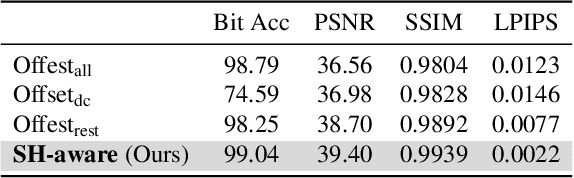
3D Gaussian Splatting (3DGS) has recently created impressive assets for various applications. However, the copyright of these assets is not well protected as existing watermarking methods are not suited for 3DGS considering security, capacity, and invisibility. Besides, these methods often require hours or even days for optimization, limiting the application scenarios. In this paper, we propose GuardSplat, an innovative and efficient framework that effectively protects the copyright of 3DGS assets. Specifically, 1) We first propose a CLIP-guided Message Decoupling Optimization module for training the message decoder, leveraging CLIP's aligning capability and rich representations to achieve a high extraction accuracy with minimal optimization costs, presenting exceptional capability and efficiency. 2) Then, we propose a Spherical-harmonic-aware (SH-aware) Message Embedding module tailored for 3DGS, which employs a set of SH offsets to seamlessly embed the message into the SH features of each 3D Gaussian while maintaining the original 3D structure. It enables the 3DGS assets to be watermarked with minimal fidelity trade-offs and prevents malicious users from removing the messages from the model files, meeting the demands for invisibility and security. 3) We further propose an Anti-distortion Message Extraction module to improve robustness against various visual distortions. Extensive experiments demonstrate that GuardSplat outperforms the state-of-the-art methods and achieves fast optimization speed.
Progressive Pretext Task Learning for Human Trajectory Prediction
Jul 16, 2024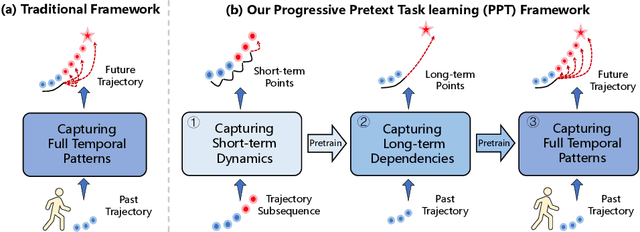

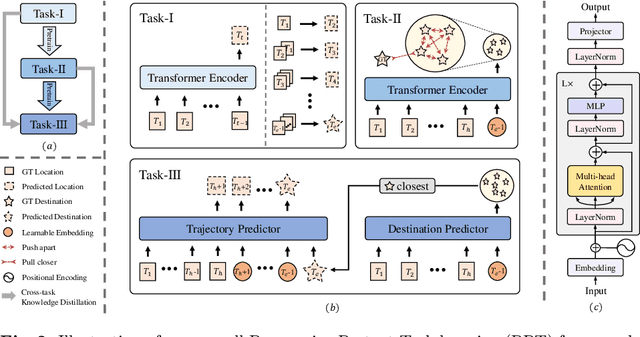
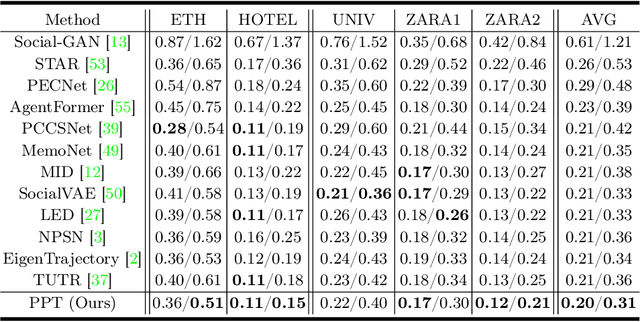
Human trajectory prediction is a practical task of predicting the future positions of pedestrians on the road, which typically covers all temporal ranges from short-term to long-term within a trajectory. However, existing works attempt to address the entire trajectory prediction with a singular, uniform training paradigm, neglecting the distinction between short-term and long-term dynamics in human trajectories. To overcome this limitation, we introduce a novel Progressive Pretext Task learning (PPT) framework, which progressively enhances the model's capacity of capturing short-term dynamics and long-term dependencies for the final entire trajectory prediction. Specifically, we elaborately design three stages of training tasks in the PPT framework. In the first stage, the model learns to comprehend the short-term dynamics through a stepwise next-position prediction task. In the second stage, the model is further enhanced to understand long-term dependencies through a destination prediction task. In the final stage, the model aims to address the entire future trajectory task by taking full advantage of the knowledge from previous stages. To alleviate the knowledge forgetting, we further apply a cross-task knowledge distillation. Additionally, we design a Transformer-based trajectory predictor, which is able to achieve highly efficient two-step reasoning by integrating a destination-driven prediction strategy and a group of learnable prompt embeddings. Extensive experiments on popular benchmarks have demonstrated that our proposed approach achieves state-of-the-art performance with high efficiency. Code is available at https://github.com/iSEE-Laboratory/PPT.